Florida Ranks 35th in Child Well-Being: 2022
Kids Count Data Book Focuses On Youth Mental
Health
August 10,
2022 07:30 am
Photo: CDC
| Columbia County Observer
graphic
 By
Sadaf Knight & FPI Staff
By
Sadaf Knight & FPI Staff
ORLANDO, FL – Florida ranks 35th in the
nation for child well-being, according to
the 2022 KIDS COUNT® Data Book, a 50-state
report of recent household data developed by
the Annie E. Casey Foundation analyzing how
children and families are faring.
This year’s annual resource focuses on
youth mental health, concurring with a
recent assessment by the U.S. surgeon
general that conditions amount to a mental
health pandemic for youth.
 The
report sheds light on the health, economic,
and other challenges affecting Florida’s and
America’s children as well as how those
challenges are more likely to affect
children of color.
The
report sheds light on the health, economic,
and other challenges affecting Florida’s and
America’s children as well as how those
challenges are more likely to affect
children of color.
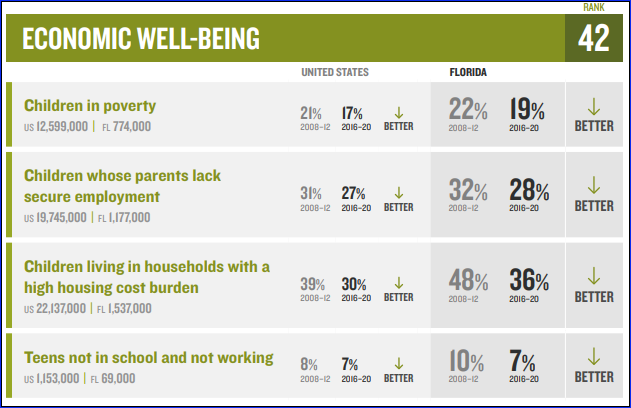
Among the four domains that make up the
index, the state ranks 42nd for economic
well-being, 35th for health, 32nd for family
and community, and 13th for education.
Although none of the indicators in
the Data Book explicitly measure mental
health, the four domains are intrinsically
tied to children’s wellness. The difficulty
in trying to put food on the table and
afford rent on poverty-level wages, for
example, does not just impact the parents in
a household — children experience this
stress as well.
One in five children in Florida is
living in poverty
 “The
child well-being index shows that one in
five children in Florida is living in
poverty, and more than one in three lives in
a household that spends over 30% of income
on rent or a mortgage,” said Norín Dollard,
senior policy analyst and KIDS COUNT
director at Florida Policy Institute (FPI).
“Also, we are just starting to see the harsh
effects of the pandemic reflected in data.
The economic downturn caused by COVID
continues to reverberate in Florida
communities, disproportionately impacting
families with low income and Black and
Latina/o families.”
“The
child well-being index shows that one in
five children in Florida is living in
poverty, and more than one in three lives in
a household that spends over 30% of income
on rent or a mortgage,” said Norín Dollard,
senior policy analyst and KIDS COUNT
director at Florida Policy Institute (FPI).
“Also, we are just starting to see the harsh
effects of the pandemic reflected in data.
The economic downturn caused by COVID
continues to reverberate in Florida
communities, disproportionately impacting
families with low income and Black and
Latina/o families.”
“As the third largest state in the
nation, Florida should aspire to be a
destination for our children," said Robert
D. Bridges, EVP & Chief Executive- FL
Operations, Nemours Children’s Health. “We
must continue to make meaningful investments
through the critical years of development
and education, to increase the likelihood
that our children will grow into productive
adults. Now is the time for Florida to take
the biggest leap yet and lead other states
for a better future.”
The Data Book reports that children
across America were more likely to encounter
anxiety or depression during the first year
of the COVID-19 crisis than previously, with
the national figure jumping 26%, from 9.4%
of children ages 3-17 (5.8 million kids) in
2016 to 11.8% (7.3 million) in 2020, the
year COVID-19 swept across the United
States.
In Florida,
more than 376,000 young people are
struggling to make it through the day.
In Florida, the share of children ages
3-17 with anxiety or depression increased
21.8%, from 8.7% in 2016 to 10.6% in 2020,
representing a total of more than 376,000
young people who are struggling to make it
through the day.
Racial and ethnic disparities contribute
to disproportionately troubling mental
health and wellness conditions among
children of color.
Nationally, 9% of high schoolers overall
but 12% of Black students, 13% of students
of two or more races and 26% of American
Indian or Native Alaskan high schoolers
attempted suicide in the year prior to the
pandemic. Further, many LGBTQ young people
are encountering challenges as they seek
mental health support. Among heterosexual
high school students of all races and
ethnicities, 6% attempted suicide; the share
was 23% for gay, lesbian or bisexual
students.
Each year, the Data Book presents
national and state data from 16 indicators
in four domains — economic well-being,
education, health, and family and community
factors — and ranks the states according to
how children are faring overall. The data in
this year’s report are a mix of pre-pandemic
and more recent figures and are the latest
available.
Investing in Mental Health: Improves
Well-Being of Children
“By investing in mental health services
and strengthening the safety net, state
lawmakers can help ensure that children in
Florida will be able to thrive,” added
Dollard.
The Annie E. Casey Foundation calls for
lawmakers to heed the surgeon general’s
warning and respond by developing programs
and policies to ease mental health burdens
on children and their families. They urge
policymakers to:
• Prioritize meeting kids’ basic
needs. Youth who grow up in poverty are
two to three times more likely to
develop mental health conditions than
their peers. Children need a solid
foundation of nutritious food, stable
housing and safe neighborhoods — and
their families need financial stability
— to foster positive mental health and
wellness.
• Ensure every child has access to the
mental health care they need, when and
where they need it. Schools should
increase the presence of social workers,
psychologists and other mental health
professionals on staff and strive to
meet the 250-to-1 ratio of students to
counselors recommended by the American
School Counselor Association, and they
can work with local health care
providers and local and state
governments to make additional federal
resources available and coordinate
treatment.
• Bolster mental health care that takes
into account young people’s experiences
and identities. It should be
trauma-informed — designed to promote a
child’s healing and emotional security —
and culturally relevant to the child’s
life. It should be informed by the
latest evidence and research and should
be geared toward early intervention,
which can be especially important in the
absence of a formal diagnosis of mental
illness.
---
Sadaf Knight
has over 12 years of experience in public
policy research, advocacy and nonprofit
management. She is CEO of Florida Policy
Institute
Florida Policy Institute is an
independent, nonpartisan and nonprofit
organization dedicated to advancing state
policies and budgets that improve the
economic mobility and quality of life for
all Floridians.
FPI is Florida's KIDS COUNT® partner