Columbia Cnty EMS – Part III: County Heads to LSHA With Hand Out
June 10, 2026 8:32 am |
6
min read |
Part I •
Part II •
Part III
AI Summary in a minute

Photo: Jon LCE via Unsplash, hand vis Unsplash | Columbia County
Observer graphic
COLUMBIA COUNTY, FL – The ongoing EMS crisis brought County officials to the June 8 Lake Shore Hospital Authority board meeting, seeking $1.63 million to purchase three advanced life support ambulances. The County claimed the investment is urgently needed to address dangerously high response times in the county’s remote northern and southern ends.
Background and the Present Crisis
In 2011, rather than fix its problematic EMS system, and as a way to bust the union, the County disbanded its EMS system in favor of privatizing the service.
Columbia County Fire Chief Jeff Crawford and County Manager David Kraus explained that County EMS is now on its fourth private contractor, AmeriPro, which is plagued by excessive call volumes per unit, staffing shortages, and response times that sometimes leave residents in growing, lower-income outlying areas waiting so long that at times they arrange their own transportation to hospitals.
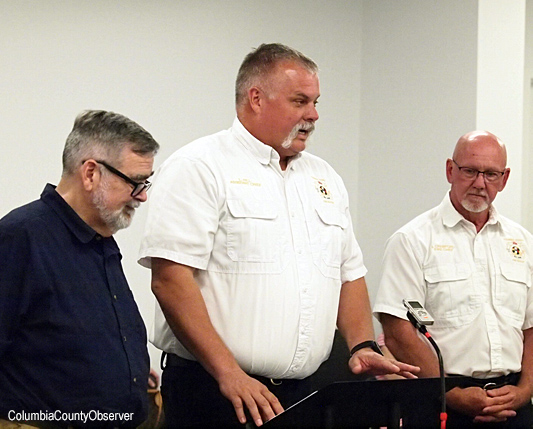
Lance Hill (center), David Kraus (left), Jeff
Crawford (center): the County hands-out-team.
The County claimed that AmeriPro is missing critical emergency response times. They are struggling through their 60-day ramp-up grace period, which ends on June 27. When asked by LSHA member Don Kennedy how he would rate the provider's current performance, County Manager David Kraus said, “They're slightly under 70%."
During the meeting, Authority Board member Don Kennedy reviewed the numbers, saying there was a tremendous strain on the existing medical transport network. Last year, the county received 15,001 calls. Mr. Kennedy calculated the system's hourly burden as unmanageable without severe delays.
Board member Brandon Beil also came to the meeting with a litany of questions regarding the County’s EMS operations.
Everybody Has a License to Operate in Columbia County
The County's self-defeating history over the past 15 years was brought to the fore by Board member Brandon Beil. He wanted to know how many COPCN’s were handed out by the County.
What is a COPCN?
A COPCN stands for Certificate of Public Convenience and Necessity. It is a regulatory legal document issued by a local county government that grants permission to an ambulance or medical transport company to operate within that specific county.
Counties can issue COPCNs for several distinct tiers of medical transport. Columbia County’s infamous County 5 (the elected County Commission) appears not to have understood that. If or when The 5 grasp the issue, it will take years to unravel.
Fire Chief Crawford said, “There's probably eight or 10 total, and a couple helicopters.”
Mr. Beil asked, “If we keep passing out COPCNs like candy on Halloween, how is anybody ever going to find staff?”
Chief Crawford answered, “They're not; that's an issue, and now the only thing that a county-based EMS system has above a private one is our retirement system.”
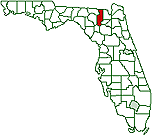
For comparison, Alachua County spans 969 square miles, while Columbia County spans 801 square miles. Alachua County has issued 3 COPCNs to non-governmental operators compared to Columbia County’s “probably eight or 10 total, and a couple helicopters.”
The Pitch: Funding the Frontlines
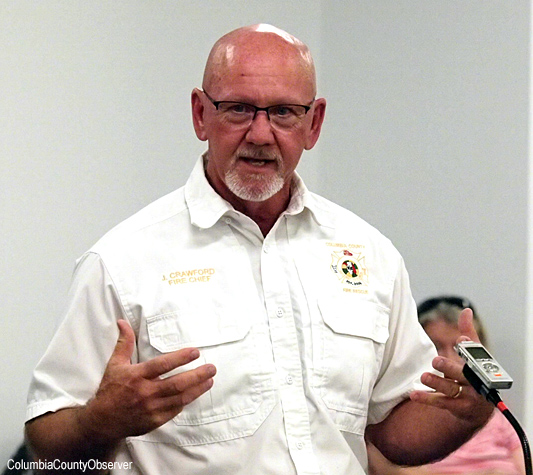
County Fire Chief Jeff Crawford. He lead the
charge for the County not to consolidate the
City and County fire departments and has only
recently been forthcoming about the
deterioration of EMS. Here is is making his
pitch to the LSHA.
Without any kind of plan and only an undated, vague, unsupported letter to the LSHA board, Chief Crawford made his pitch.
Chief Crawford asked the LSHA to provide the upfront capital to circumvent the failing AmeriPro contract.
The Chief did not mention that AmeriPro’s contract was recently revamped by County Attorney Joel Foreman and approved by the County 5.
Outfitting the County fire service with its own ambulances requires heavy initial investment:
• Three Ambulances (Chassis and Boxes):\1,221,672$
• Medical Equipment (Monitors, stretchers, suction units): \407,663$
• Total Request:\1,629,335$
Chief Crawford explained that by providing two active 24/7 ambulances and one fully-stocked spare, the Fire Department could dispatch cross-trained firefighter-paramedics to 911 calls, plugging the hazardous gaps left by AmeriPro. He said that if funding is guaranteed this week, the county could jump the line to reserve demo trucks, taking delivery of two by December and the third by January, avoiding the typical year-and-a-half manufacturing delay.
County Manager Kraus came up with a unique argument for funding. He emphasized that the ambulances would transport patients to the nearest appropriate hospital, directly tying the service to healthcare facilities. “The whole point of the ambulance is to transport people to the hospitals, so it is related to the facilities,” he said.
Mr. Kraus acknowledged not everyone in those remote areas is low-income, but said there are “a lot of low-income people” and that delays have already forced some residents to find alternative transportation during life-threatening situations.
No one on the County team mentioned that South Columbia County is not remote, as it has become a bedroom community for Alachua County due to its lower taxes.
Northern Columbia County does have remote areas, as it abuts the National Forrest. It is well known throughout America that if one moves to a remote area, the services are not the same as in the populated areas.
Citizen Push Back: “Resign Tonight”
The proposal was not without its heavy detractors. During the public comment period, the LSHA Board faced intense scrutiny over the legality of the move.
Residents Barbara Lemley and Stew Lilker argued that purchasing the ambulances violates the LSHA’s statutory enabling legislation, which is specifically designed to fund indigent care and hospital-related facilities.
Citizen and Authority critic Barbara Lemley did not pull her punches. She accused the trustees of acting outside the law. "You got rules to follow, laws to follow, and if you give them money, you know you're not doing what you're supposed to do." "What you guys really need to do is just resign tonight – turn it all over to the county.”
Your reporter, who is also a property owner and taxpayer of Columbia County, weighed in, pressing the indigent care question. He noted that the authority's purpose is providing care for indigent residents — yet the letters provided by the County cited only a vague "large population" of indigents without data. "Where are these areas of extreme indigent poverty?" he asked.
He also flagged a missing map from the AmeriPro contract defining the underserved zones, and recalled that former Authority Attorney Marlin Feagle once blocked a door-replacement request as outside the enabling legislation's scope. “I feel that you're violating the law if you do this,” he said.
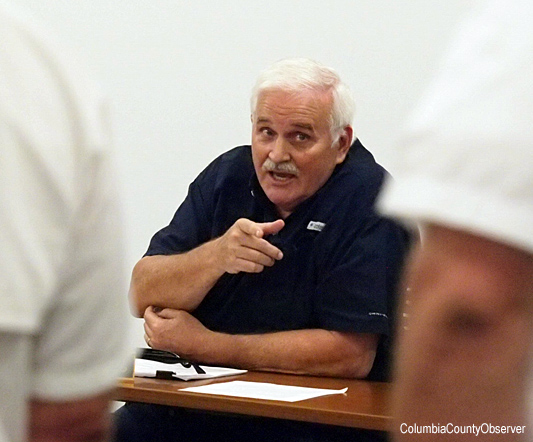
Former County Manager Dale Williams has been at
the helm of the Authority during its downfall as
it became the "authority" for handouts.
Legal Questions and the Path Forward
The push-back by Ms. Lemley and your reporter had the LSHA contracted attorney, Todd Kennon, thinking.
Mr. Kennon advised the board that any assistance must align with the Authority’s enabling legislation, which authorizes agreements with healthcare providers and services for indigent residents of Columbia County.
Mr. Kennon suggested that a broad reading could support actions to assist indigents in need of transport. However, he recommended proceeding only through a formal interlocal agreement that would include safeguards: ambulances used only for Columbia County 911 calls, title remaining with the county as a governmental entity, and reversion rights to the LSHA if the county later exited EMS or no longer needed the units.
Authority Board member Jerry Bullard said he would vote against the proposal at this stage because the County Commission had not yet held its planned workshop or produced a comprehensive plan. “The commission has not even met on this and given a plan,” Mr. Bullard said. “Tonight, I would vote no about doing it until I see a better plan in place… We don’t know if we’re right, and I want to make sure we’re right before we move on with it.”
Board member Kennedy expressed strong support in principle, citing the LSHA’s long history of partnership with the county (he gave no examples) and arguing the ambulances were “just as good, competent as a hospital room.”
Former County Manager Dale Williams, the Authority’s part-time executive director, asked the board for a clear indication of its sentiment to carry to the County commission’s upcoming special meeting.
Cognizant of the Authority’s questionable legal status, he summarized the room's sense as a majority willingness to assist, provided a proper legal finding and a sustainable business model were in place.
Chairman Stephen Douglas agreed that the legality determination was “the stickler.” The board stopped short of any commitment.
Chief Crawford closed by warning that the County could not afford to wait a year or two for new revenue sources. “We’ve got that big issue going on. We have to make a change now… We don’t want it to progress to where that issue is somebody’s life.”
Epilogue
The County 5 meets this morning at 10:30 to discuss the issue and possibly do something.
As of 5 am, there is no supporting information for the agenda. The meeting has been scheduled for a week.
What the infamous County 5 will do is anybody’s guess.
